The foreign trade platform that runs your machinery export operation
A machinery sale moves through months of quote rounds, letter of credit terms and project-based production; miss a single date and a high-value payment is at risk. Sighthem keeps the entire flow on one platform for machinery and equipment exporters, from quote revisions to work orders, packing lists and the COMMERCIAL INVOICE. Stop splitting a long sales cycle across spreadsheets and disconnected tools; let every step feed from the one before it.
Finding buyers in a niche market: the right plant, the right decision maker
In machinery exports buyers are few and every one of them counts; knowing who is investing in your target market is half the job. Sighthem keeps prospecting in the same flow as the CRM.
- List manufacturers and plants in your target market with company discovery; confirm the emails of purchasing and technical decision makers with the discovery and verification service, and stop writing to dead addresses
- Nurture buyers through a long decision process with segmented email sequences; see who is warming up from open and click data, and time your call accordingly
- Scan the business cards you collect at machinery fairs with the mobile PWA; OCR creates the lead automatically and fair leads stay tracked per event
- Call foreign buyers with live translation on the line; message them over the official WhatsApp API or the QR pairing mode, and keep every touchpoint on a single customer card
Quote rounds that run for months: revision history and buyer approval on record
A high-value machinery quote typically goes through several rounds of revision; which configuration and which price were discussed must never get lost. In Sighthem, quote, proforma and order are a single flow.
- Build the quote with main machine, option and accessory lines; every revision is kept in history, so the version the buyer approved is beyond dispute
- Fix the Incoterm and currencies at the quote stage, so a EUR quote and USD freight never blur into the document chain
- Record the agreed payment terms (advance, balance, letter of credit) on the order note; track the critical dates with activities, notifications and letter of credit date alerts so the balance step never slips
- Capture buyer approval in the system; the approved proforma converts to an order in one click, with no retyping of quantities or prices
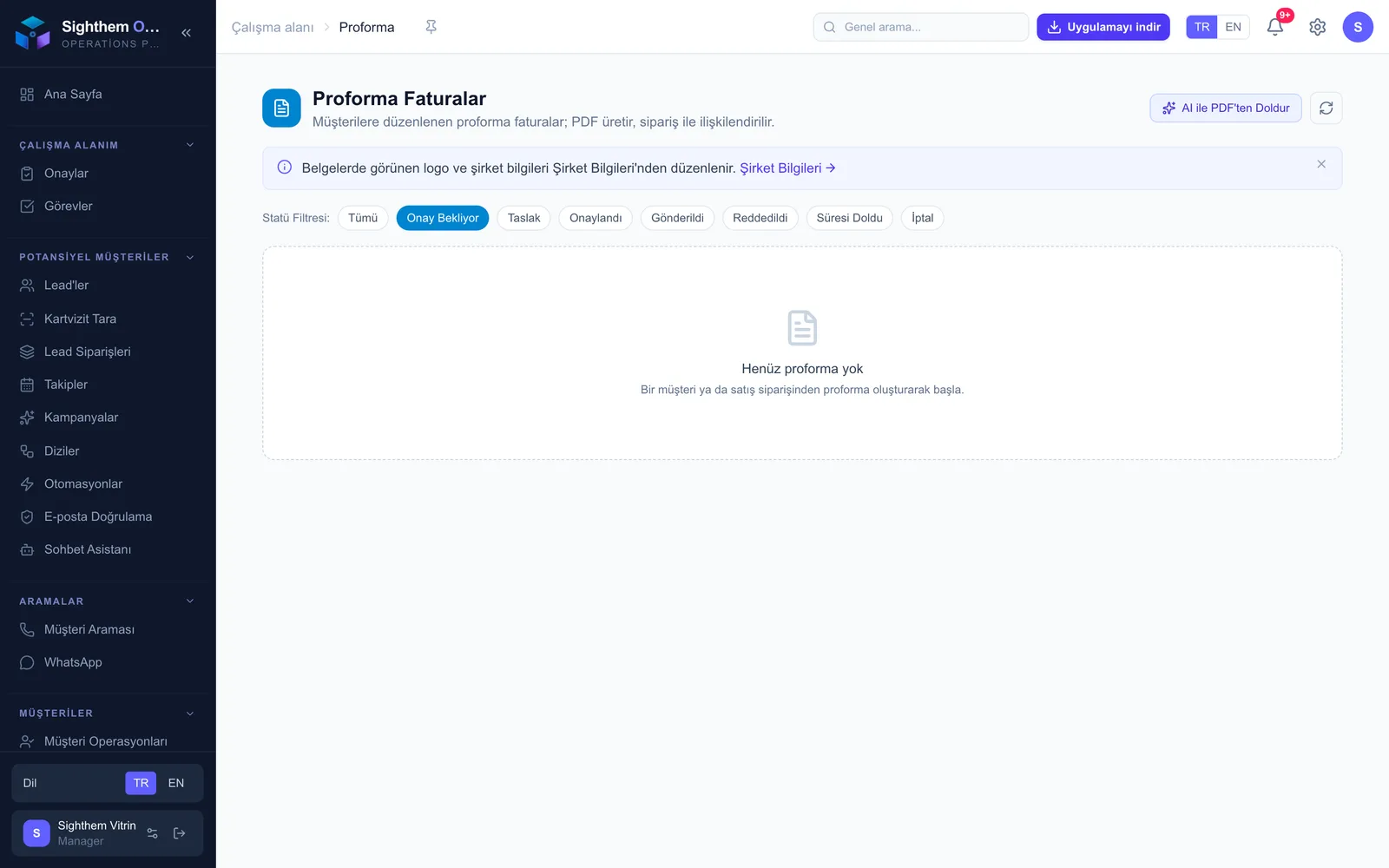
Letter of credit and technical documents: the paperwork discipline behind high-value collections
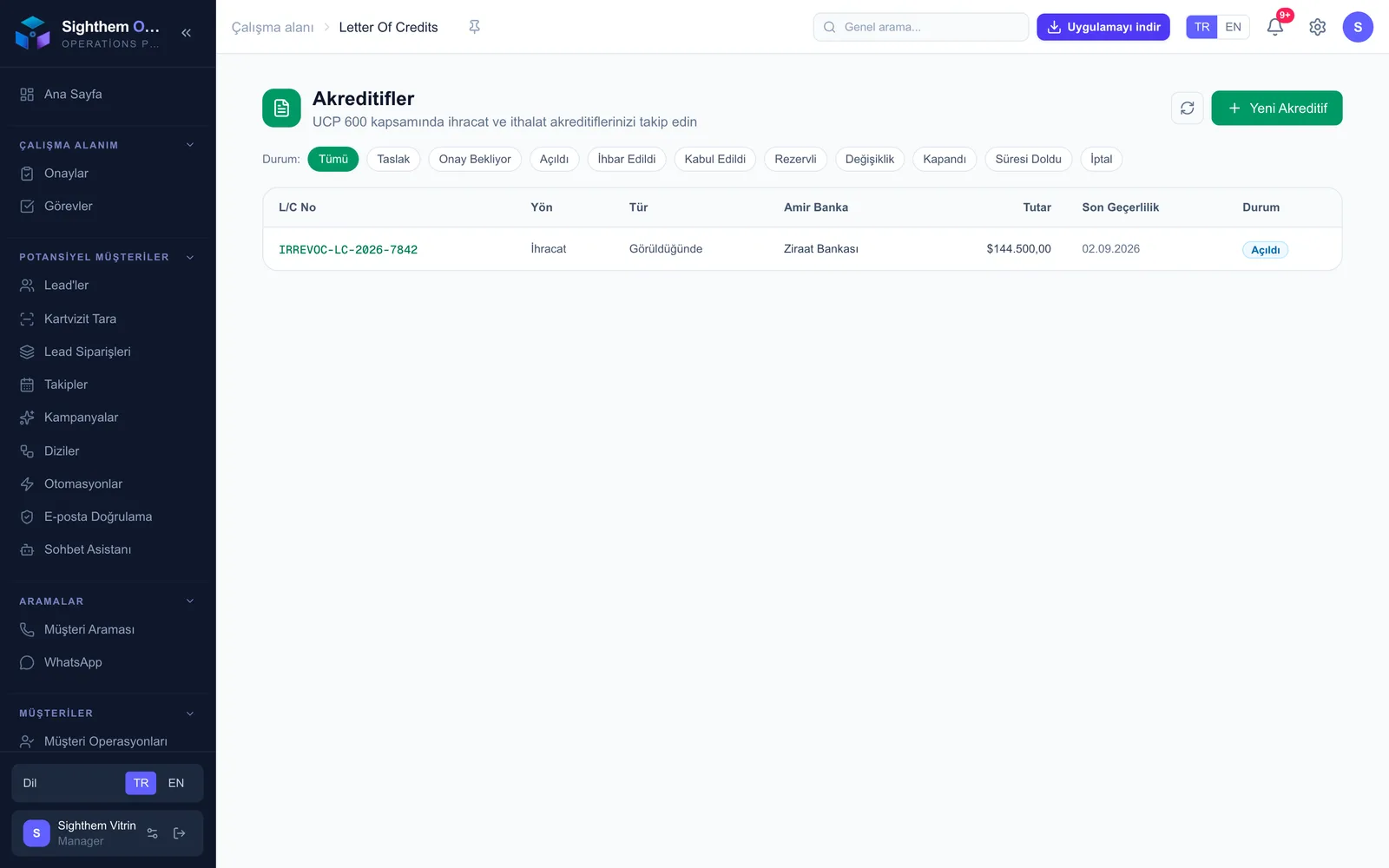
Machinery exports are paid largely under letters of credit, and the document set does not end with the standard paperwork; technical documents go into the presentation too. Sighthem offers L/C and document tracking as a native module.
- Bring the L/C text into the system with AI-assisted reading; latest shipment and presentation dates go under automatic tracking and you get alerts as deadlines approach
- Collect the document set (bill of lading, COMMERCIAL INVOICE, packing list, certificate of origin, insurance, certificates) in a single list, and spot a missing document before shipment
- Add technical documents and certificates to the same set; check from one screen whether every document the L/C demands is ready
- Link every document to its order and shipment, and catch discrepancy risk before the bank presentation
Project-based production: from work order to quality sign-off
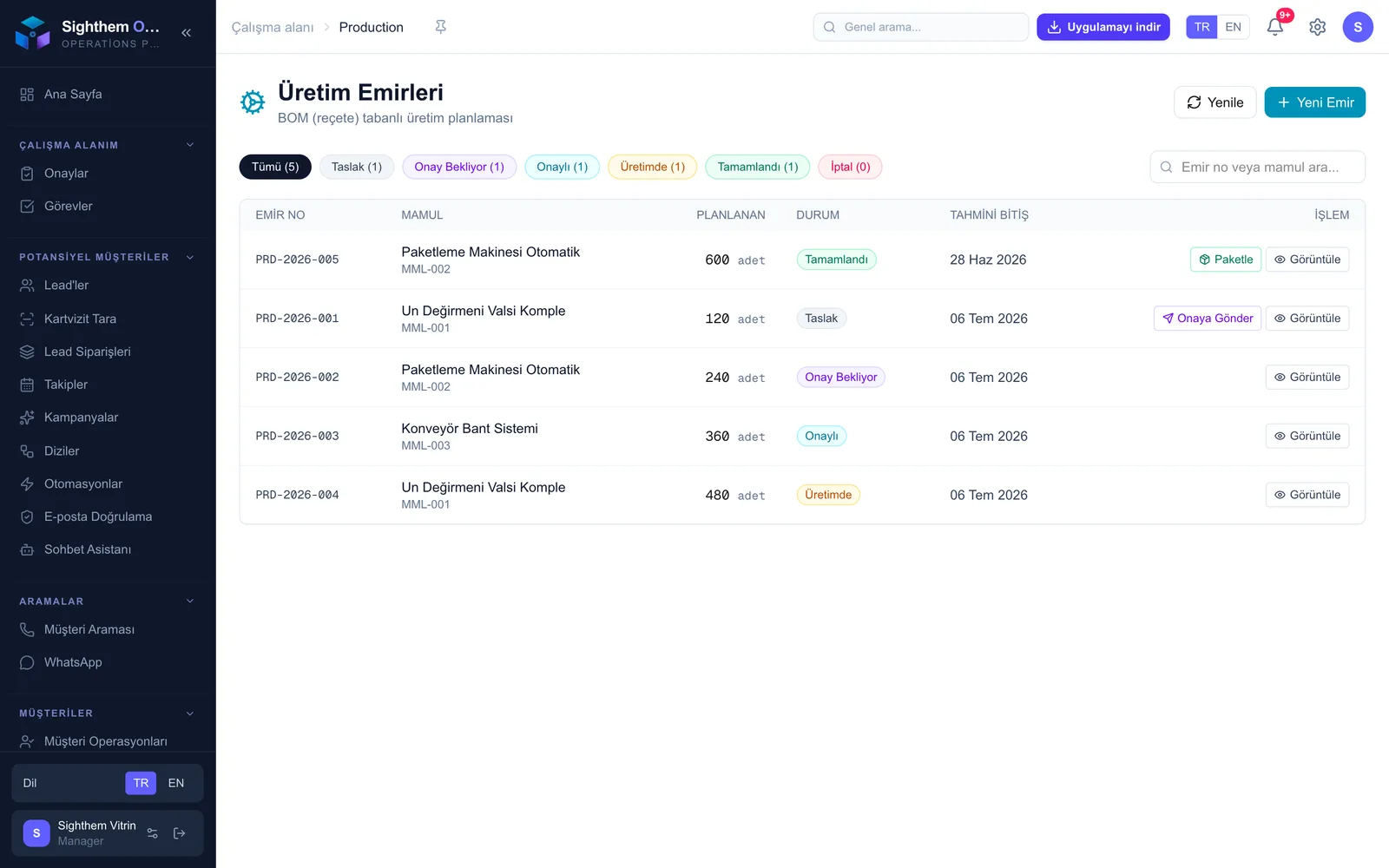
Every machine order carries its own work order, its own bill of materials and its own quality process. Sighthem runs the production side attached to the order flow.
- Open a work order tied to the order; define which components are needed and in what quantity with the BOM, and let stock be reserved per order
- Raise a purchase order (PO) for missing components; check invoice, order and goods receipt with 3-way matching, and track the supplier account in the same place
- Bind critical steps to manager approval with the production approval flow; who approved what, and when, stays on record
- Run quality control (QC) in the system; issue a certificate of conformity, record any issue with a nonconformity report, and go into shipment clean
Multi-crate shipments and customs: from packing list to HS codes
A machine rarely travels in a single crate; the body, panels and accessories leave in separate cases, sometimes in separate containers. Sighthem binds the shipment at package and pallet level and keeps the customs side in the same flow.
- Bind shipment lines to packages and pallets; generate a packing list that mirrors the part list straight from the system, with no hand-kept sheets
- Manage partial shipments from a single order; see line by line which crate went in which container, and what has shipped versus what is still waiting
- Keep forwarder, container and demurrage tracking on the shipment record, and know where every load is without asking around
- Store the different GTIP (HS) codes of the main machine, panels and parts on their product cards; link declarations to shipments, and track the VAT refund file and DIIB-covered imported inputs from the same place
Spare parts, invoicing and reporting: after-sales on the same platform
A machinery sale does not end at delivery; spare parts orders are a revenue channel that runs for years. Sighthem manages small, frequent parts sales in the same system as the big project order.
- Load your spare parts catalog through the Excel stock import; track parts stock separately across multiple warehouses and pick with GS1 barcode scanning
- Stock is reserved per order on parts sales, so the same part is never promised to two customers at once
- Issue a COMMERCIAL INVOICE for exports and a GIB-compliant UBL-TR e-invoice for domestic sales; the system works with your e-invoice integrator
- Narrow order, shipment, production and lead reports with the column selector and download them to Excel; role-based permissions and the approval center keep the team on the same data in a TR+EN interface
When quote revisions, L/C dates and the packing list all feed from the same order record, the debate over which version is current disappears from a months-long machinery sale. The team works from a single source instead of copying spreadsheets, and the inconsistencies in the document chain go with it.
Set up product cards with separate GTIP (HS) codes for the main machine, panels and spare parts from day one. When the declaration and VAT refund stages arrive you will not be hunting for tariff positions, and packing list and invoice lines separate cleanly from the start.
In project-based production, a slipping deadline threatens the latest shipment date on the letter of credit. Watch work order progress alongside the L/C dates; once a delay becomes visible, raise the amendment request well before you are squeezed against the bank presentation.
Frequently Asked Questions
Machinery sales cycles run for months; how do you handle quote revisions?
In Sighthem, quote, proforma and order are one flow and every revision is kept with its history. When the configuration or price changes, a new version is created and the version the buyer approved is clearly marked. Months later, 'what price did we agree on' is answered by looking at the revision history, not by digging through files. The approved proforma converts to an order in one click.
What does the system track on L/C sales?
You bring the L/C text into the system with AI-assisted reading; latest shipment and presentation dates go under tracking and you get alerts as deadlines approach. The document set (bill of lading, COMMERCIAL INVOICE, packing list, certificate of origin, insurance, certificates) sits in a single list, and a missing document is visible before shipment. Technical documents and certificates go into the same set. Because every document is linked to its order and shipment, discrepancy risk is caught early.
How do project-based production and quality control work?
You open a work order tied to each order and define component needs with the BOM; stock is reserved per order. For missing components you raise a purchase order and check the invoice, order and goods receipt with 3-way matching. The production approval flow binds critical steps to manager approval. Quality control ends with a certificate of conformity, and any issue is recorded with a nonconformity report.
The machine ships in multiple crates and containers; are packing lists and partial shipments supported?
Yes. Shipment lines are bound to packages and pallets, and a packing list that mirrors the part list is generated from the system. Partial shipments are managed from a single order; which crate has gone and what is still waiting is visible line by line. Forwarder, container and demurrage details sit on the shipment record. The COMMERCIAL INVOICE is fed from the same shipment data.
Can I manage spare parts sales in the same system?
Yes. You load the spare parts catalog through the Excel stock import and track parts stock separately across multiple warehouses. Stock is reserved per order on parts sales, and picking is done with GS1 barcode scanning. Small parts orders sit on the same customer card as the big project orders, so after-sales revenue never moves to a separate program.
How do you track different GTIP (HS) codes, DIIB and the VAT refund?
The GTIP codes of the main machine, panels and parts are stored on their product cards, and declarations are linked to shipments. For imported inputs under the inward processing permit (DIIB), inputs, offsets and commitment closure are tracked. Documents and amounts that go into the VAT refund file are collected against the export transaction. Reports can be narrowed with the column selector and downloaded to Excel.
Run the long sales cycle, the letter of credit and the multi-crate shipment on one platform. Try Sighthem free for 14 days on the PRO plan, no card required.
Start a 14-day PRO trial · L/C tracking · Customs & tariff tracking · Finding export customers · All industries · See pricing